Does Soy Help Bone Health in Menopause? A Dietitian’s Take
When women ask me about bone health, they usually want to know which foods are best for their bones.
Most people immediately think about dairy — and that makes sense. Dairy foods can be excellent sources of both calcium and protein.
What often surprises women is when I suggest soy foods as another option.
Building bones is like building a house. Before you worry about the colour of the walls or the throw pillows, you need to build a solid foundation. For bones, that foundation is:
- Enough protein
- Enough calcium
- Enough vitamin D
- Some form of regular strength or resistance work
If those pieces aren’t in place, adding one “bone-friendly” food won’t do much. That doesn’t mean food choices don’t matter — they do — but how they fit into an eating pattern matters much more.
Let’s look at where and why soy foods might be a good fit in your bone building foundation.
Key Takeaways
Bone health in menopause depends on the basics — enough protein, calcium, vitamin D, and strength work. Soy foods can help meet those needs and may offer small added benefits for bones, heart health, and hot flashes..

Bone Health Needs Attention During Menopause
Menopause is a time when many women need to start paying more attention to their bones (we need to start paying attention to our bones much earlier but many of us haven’t, so here we are).
Before menopause, our estrogen helps slow bone breakdown and supports the ongoing process of rebuilding bone. When estrogen levels drop during menopause, that balance shifts. Bone is broken down faster than it’s built, and over time, bone density can slowly decline.
There are usually no symptoms, which is why bone health often flies under the radar until a bone scan or a fracture brings it to attention.


Why Soy could Help your Bones
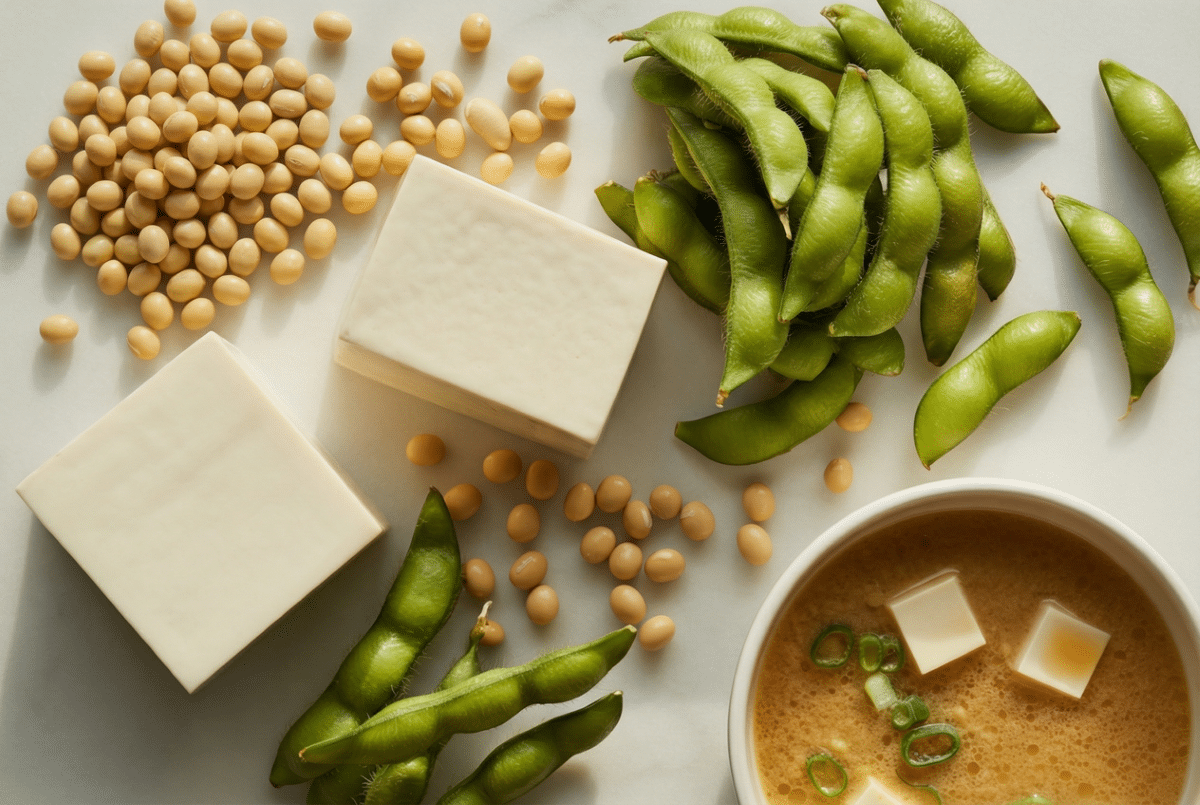
Soy foods — things like tofu, soy milk, and edamame — have been studied for bone health for a few reasons.
First, soy is a high-quality source of protein, which we know is important for maintaining bone and muscle as we age. Many soy foods also contain calcium, especially fortified soy milk and calcium-set tofu.
But interest in soy foods for bone health was sparked by observations that osteoporosis rates were lower in some East Asian populations, where soy foods are eaten regularly.
Researchers wondered if the natural plant compounds called isoflavones in soy could be playing a role. These compounds look similar enough to estrogen that they can attach to estrogen receptors in bone.
When that happens, they may help gently support bone building and slow bone loss during menopause.

Soy might not be Equal for Everyone
This is where the soy story gets more interesting — and a little more complex.
Isoflavones don’t work the same way in every body. One reason is differences in gut bacteria.
Some people have specific gut bacteria that can turn one of isoflavones (called daidzein) into another compound known as equol.
Equol appears to interact more strongly with estrogen receptors than the isoflavones on their own.
This process appears to be more common in East Asian populations. In North America, only about one-third of women seem to experience it. Which can help to explain why some studies show stronger bone effects from soy than others.
So does this mean you should try to figure out whether your body makes equol?
Sadly, there’s no simple or practical way to test for that, so at this point there is no way to know for sure.
The more important point is this: even without equol, soy foods can still be helpful. Soy can help bones hold onto the calcium you do eat, regardless of how your body processes soy isoflavones.
If soy is a food you enjoy, or are curious to experiment with, it makes sense to include it more regularly.
Soy Helps More than Bones in Menopause
Even though soy’s effects on bone may be modest, bone health isn’t the only reason I suggest it.
Soy foods have also been linked with heart health benefits. Since heart disease risk increases after menopause it is important to look at our eating patterns in midlife.
Replacing some animal proteins with plant proteins like soy can help support cholesterol levels and overall heart health.
There’s also some evidence that increasing soy foods may help reduce hot flashes for some women. As with bone health, the response isn’t universal. Some women notice fewer or less intense hot flashes, while others don’t notice much change.
See: Best Foods that Fight Hot Flashes
Still, when a food has the potential to help — without much downside — it can be worth considering.

How Much Soy Should I Eat?
If you’re wondering how much soy you’d need to eat to see potential benefits, the good news is that we’re not talking about extreme amounts.
Most research looks at amounts that are similar to what you might get from one to two servings of soy foods per day. That could look like:
- A glass of fortified soy milk
- Tofu added to a stir-fry or salad
- Edamame as a snack or side
- Tempeh used in place of meat in a meal
Try using soy milk in oatmeal, adding tofu to a familiar stir-fry, or keeping frozen edamame pods on hand for quick snacks.
If soy isn’t a food you enjoy, there’s no requirement to add it. Bone health and heart health can be supported in many ways. But if you do enjoy soy or are curious to experiment, this is a very reasonable way to include it.

What About Soy Supplements?
It’s reasonable to wonder whether soy supplements — like isoflavone capsules — might work better than food.
So far, the research doesn’t really support that idea.
Research on soy supplements is mixed. Larger doses don’t appear to offer extra benefits compared to the amounts found in foods.
More importantly, supplements don’t offer the same overall benefits as soy foods. When you eat soy as food, you’re also getting protein, and often calcium — both of which matter far more for bone health than isoflavones alone.
For these reasons, I generally don’t recommend soy supplements for bone health.
Bone health in menopause is built on the basics: enough protein, calcium, vitamin D, and regular strength work.
Soy foods can help meet those needs. They provide high-quality plant protein, often contribute calcium, and may offer small added benefits for bones, heart health, and hot flashes.
If you enjoy soy, one or two servings a day can be a practical, food-first option. If you don’t, there are many other ways to support your bones.

Looking for ongoing support around food, body, and menopause?

Hi, I’m Sandra!
I’m a registered dietitian and body confidence coach specializing in midlife health and menopause nutrition.
I offer virtual nutrition counselling and coaching for women in British Columbia, Canada.
I help women thrive by moving away from restriction and toward nourishment—through practical strategies and compassionate support that honor your changing body.
My focus is on helping you feel confident, strong, and well-fed.
Learn more about working with me